

India accounts for a staggering 25% of the world’s milk output. But we don’t rely on Western mega-farms to pull this off. Our supply chain is completely decentralized, built on millions of smallholder farmers pouring milk at local Village Dairy Cooperative Societies (VDCS) and Bulk Milk Cooling centers. To grasp the scale, look at a single massive cooperative like Amul. They coordinate the collection of over 35 million liters of milk daily from 3.6 million farmers across 18,500 villages..
If you want to understand the operational brilliance required to manage this, don’t look at the massive processing plants. Look at the edges of the operation.
Walk into a village collection center at 5:00 AM. Then walk into the dispatch yard at 6:00 PM.
You will find two completely different worlds inside the same company, each battling a different monster.
At one end, there is the human element: raw bias and corruption at the collection gate. At the other, there is sheer complexity: a huge catalogue of perishable products losing value by the hour in the sales yard.
Key idea: The best operational workflows are often not “standard best practices.” They are local solutions built to solve local risks.
Both problems created brilliant, highly specific workflows on the shop floor. And both workflows break the moment a generic, off-the-shelf ERP is dropped into the middle of them.
Problem 1: Bias at the Collection Gate
Take the morning collection routine. A farmer pours the milk. The clerk weighs it. The farmer is paid based on fat and SNF, or solids-not-fat, content.
In India, raw milk procurement runs on a two-axis pricing model. Farmers get paid based on the volume of the milk and its core quality metrics: Fat content and Solids-Not-Fat (SNF).
A tiny nudge in the lab report can drastically change the payout. Unsurprisingly, this is where local collusion can thrive.
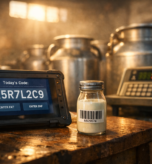
Indian dairies solved this decades ago without fancy technology. They created a practical form of zero-trust architecture using paper stickers.
The process works like this:
- The clerk taps the supplier’s permanent RFID or smart card.
- The system instantly spits out a single-use, temporary random token valid only for that day.
- The sample bottle gets the random sticker. You could call this Daily Pseudonymized Reference Tokenization, or DPRT.
- The sample moves to the lab.
- The technician tests the milk and logs the results against that random number. They have absolutely no idea whose milk they are holding.
- At the end of the shift, the system silently maps the results back to the correct farmer and calculates the exact payout.
The lab technician never knows whose milk they are testing. Nobody sees the whole picture at once.
Key concept: The process removes human bias physically, not just through policy.
Problem 2: Perishable Complexity in Dispatch
Fast forward twelve hours to the dispatch yard, and the chaos flips. The integrity problem is gone. Now the company faces a dynamic pricing and logistics nightmare.
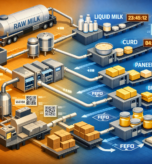
A growing SME dairy does not simply sell “milk.” It may manage 150 SKUs across toned milk, full cream milk, flavored milk, multiple types of curd, paneer, ghee, and more.
Each product has a different pack size. Each has a different shelf life, ranging from 48 hours for fresh curd to twelve months for UHT milk.
Now imagine this situation.
At 8:00 PM, a distributor calls. Local wedding demand has spiked. They want to swap 200 liters of toned milk for Kesar flavored milk.
The sales team wants to say yes to hit the monthly target. The dispatch manager checks the Kesar milk batch in the cold room. It has only 36 hours of shelf life left. The truck route takes 24 hours.
Do you ship it? If you do, you risk consumer complaints and product returns. If you don’t, you lose revenue and irritate a key distributor.
Sales is measured on volume. Operations is measured on wastage. When those incentives clash, the business bleeds money through reverse logistics and dumped stock.
Why Standard ERP Breaks These Workflows
When companies try to digitize these scenarios, standard software often fails spectacularly.
A vanilla ERP looks at the blind test and forces the lab technician to select the farmer’s name from a dropdown, destroying the anti-corruption SOP. It looks at the dispatch yard and tracks inventory by SKU, while ignoring exact batch shelf life versus a specific truck route.
Core lesson: You cannot software your way out of operational complexity. First establish hard operational guardrails, then digitize those rules.
Step 1: Start With Discovery, Not Software
When we walk into a dairy plant, we start by ignoring software catalogs. We pull up a stool next to the weighbridge. We stand in the cold room while dispatchers coordinate with drivers.
We don’t ask only what people do. We ask why they do it.
Discovery means mapping the actual, messy reality: spilled samples, manual ledger workarounds, and the clipboard math dispatchers use to decide whether a batch can survive a route.
It also means uncovering strategic misalignment. If the business strategy relies on farmer trust and preventing localized fraud, you cannot compromise the blind test. If the strategy relies on maximizing full-price sales, sales cannot override shelf-life limits without consequences.
Step 2: Design Guardrails Around the Real Workflow
Once the intent is clear, the guardrails become easier to design.
For the collection center, the process design is straightforward but requires flexible architecture. We build a specialized “Raw Milk Batch” tracker that measures both liquid volume and component mass. We hardwire the DPRT token generation into the system and lock the lab screen so the technician only sees the code. You enforce “Quality-by-Design” structurally.
For the dispatch yard, build a Transit Time Matrix. The system calculates remaining shelf life minus transit time. If the number drops below a safe buffer, such as 24 hours, the system blocks the sale of that specific batch to that specific route.
Step 3: Co-Create the Solution With the Floor
If you simply impose these rules, teams will resist. Sales will find workarounds. Lab technicians may revert to paper. That is why the solution has to be co-created with floor operators.
Bring sales, dispatch, and quality into the same room. Show them the hard block on short-life curd. They will explain what happens during a real emergency.
Then build the right exception process together. For example, an override button may be allowed, but every override should trigger an instant alert to the quality head. Run mock drills. Put a tablet in the lab technician’s hands. Watch them scan the random barcode. If they ask for an audio beep when the entry saves, add it. Small friction removals decide whether the process survives.
Step 4: Let Technology Strengthen the SOP
Only then do you implement the technology. You connect the hardware directly to the software. The electronic weighbridge pushes data to an open-source ERP platform. The ultrasonic milk analyzer pushes the fat readings. The system generates the tokens, enforces the blind test, calculates the shelf-life math, and automates the reconciliation without a single manual entry. As soon as the milk is tested, the data package is sealed, cryptographically hashed, and uploaded to the secure database. The technology doesn’t ask anyone to unlearn their fundamental SOP. It just makes the SOP faster and tamper-proof.
What good technology does: It does not ask people to abandon a strong SOP. It makes that SOP faster, more auditable, and easier to scale.
Step 5: Sustain the Change After Go-Live
Transformation often dies a few months after go-live. A key person leaves, volumes double, or fragile new habits snap under pressure. Sustaining the change requires a shift in how leadership manages the business.
Start with simple operational huddles. A ten-minute morning standup where the team looks at a 360-degree real-time executive dashboard showing what expires in the next 48 hours. Management gains instant visibility into procurement trends, residue compliance, and production yields without waiting for end-of-day manual reconciliations.
You tie the operational metrics directly back to the overarching business strategy, ensuring the platform adapts as regulatory standards shift or the business expands.
The Bigger Lesson for Indian SMEs
Every Indian SME sector has these strange, unwritten workflows. A textile unit in Tirupur may track dye lots with cryptic handwritten codes. A spice exporter in Kerala may blend raw materials using rules no textbook teaches.
These are not inefficiencies. They are the organization’s immune system.
If a system demands that the company abandon this DNA to fit a standard software template, people will quietly reject it.
Real digital transformation does not replace grassroots intelligence. It wraps that intelligence in digital muscle, builds guardrails around it, and scales it.
If you buy a system that demands you abandon that DNA just to fit a standard software template, your people will quietly reject it. Real digital transformation doesn’t replace grassroots intelligence. It wraps that intelligence in digital muscle, builds guardrails around it, and scales it.
The Bottom Line
Indian dairy operations live and die at the extremes of their supply chain. At the collection gate, a simple random sticker protects millions of rupees from human bias. In the dispatch yard, a calculated shelf-life matrix prevents costly wastage when dynamic orders collide with a massive, perishable SKU catalogue. Both are brilliant, hyper-local SOPs born out of pure necessity.
When SMEs try to digitize these environments, generic ERPs shatter this delicate operational DNA. They force businesses to choose between standard software logic and the very guardrails that actually protect their margins. The fix isn’t a bigger software package. It’s a structured transformation that maps the messy reality, builds hard process rules, co-creates with the people on the floor, and only then applies technology to enforce those rules at scale.
Every sector has its own version of the blind test or the expiry math. Your unique workflows aren’t bugs to be fixed. They are your competitive edge. Don’t let a generic system wipe them out.
Essential Blocks for Gutenberg
Want to digitize without destroying what works?
If your business relies on battle-tested workflows that standard software just doesn’t understand, let’s talk. We’ll start by pulling up a stool on your shop floor.